
Probabilistic Oil Spill Modeling for Emergency Response
- April 24, 2026
- Category: News

Marine oil spill incidents at sea represent a major challenge for maritime safety and environmental protection.
In emergency situations, authorities and response teams operating in marine and offshore environments must take rapid decisions based on reliable, real-time information. Probabilistic oil spill modeling for emergency response offers a more robust approach to oil spill trajectory forecasting by explicitly accounting for uncertainties linked to environmental conditions.
CLS, a key player in maritime safety and environmental monitoring, has developed an innovative operational methodology to enhance forecast reliability and support decision-making during marine pollution incidents
The challenges of oil spill trajectory forecasting
Oil spill trajectory models are widely used to predict the movement of hydrocarbons at sea based on ocean currents, winds, and wave conditions. These forecasts are essential to identify threatened areas, protect sensitive coastlines, and optimize response operations.
However, marine environments are highly dynamic. Sudden changes in weather conditions, shifting wind directions, and the presence of oceanic features such as eddies and meanders, pose a challenge to oil drift forecasts made with single deterministic simulations, that do not account to the uncertainties of real-world conditions.
Limitations of deterministic environmental models
Atmospheric and oceanographic models generally perform well in predicting average environmental conditions. Yet they often struggle to accurately capture short-term variability and transient phenomena, such as storms or mesoscale ocean circulation features.
Small timing errors in wind shifts or spatial displacements of ocean eddies can lead to oil spill forecasts that deviate from actual oil movement. These uncertainties may reduce the effectiveness of response strategies if they are not properly accessed and communicated.
A probabilistic methodology developed by CLS
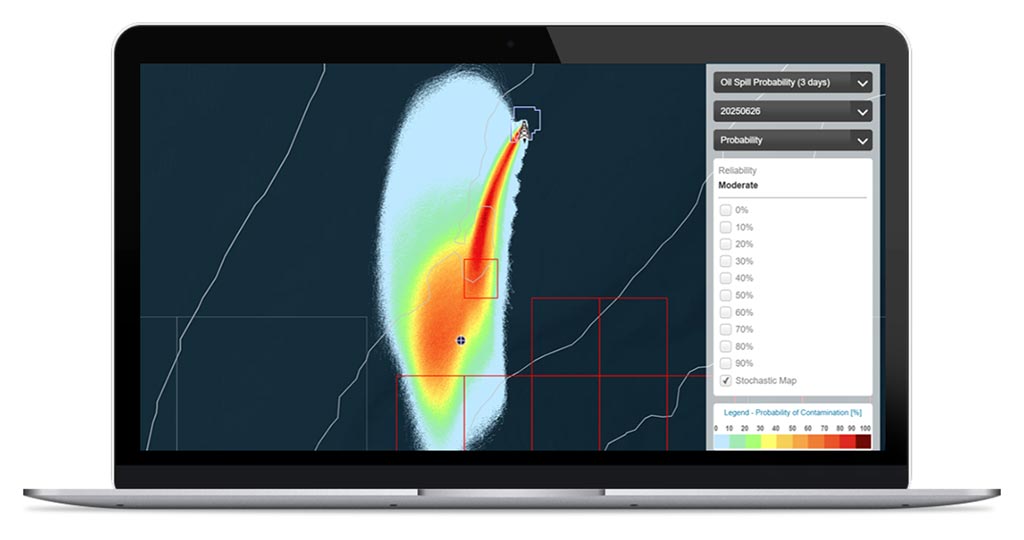 To overcome these limitations, CLS has developed a probabilistic oil spill modeling approach designed to quantify and map uncertainty in trajectory forecasts.
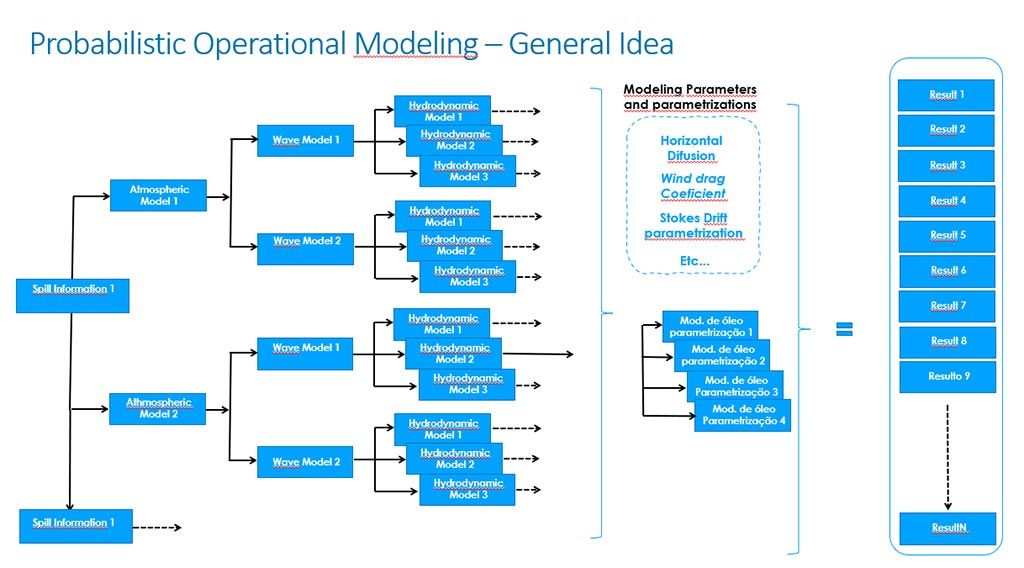
The methodology automatically generates multiple deterministic simulations for a given spill location. These simulations combine different sources of environmental data, including currents, winds, and waves.
Also, the awareness of an oil slick in the ocean involves uncertainties related to volume spilled, oil weathering state, and initial time of the leakage.
All those uncertainties may also be considered in the assemble of multiple simulations to compose the probabilistic maps.
From deterministic simulations to probabilistic results
The ensemble of simulations is then combined into a probabilistic outcome. This approach assigns greater importance to simulations that are closer to real initial conditions, while progressively reducing the influence of more distant scenarios.
The resulting probability maps provide a more comprehensive representation of potential oil spill trajectories and are less sensitive to errors in environmental data than deterministic forecasts.
The Probabilistic Uncertainty Index
Probabilistic results are used to calculate a dedicated indicator known as the Probabilistic Uncertainty Index (PUI). This index quantifies environmental variability and helps assess the reliability of deterministic forecasts.
Higher PUI values indicate greater environmental variability and a higher likelihood of inconsistencies in deterministic predictions. The entire process can be executed daily in an operational mode, without operator intervention, ensuring rapid availability of results during emergency situations.
Operational benefits for emergency response teams
By analyzing probability maps together with the Probabilistic Uncertainty Index and drifter data, response teams gain a clearer understanding of forecast uncertainty. This approach helps define extended areas of potential oil presence beyond deterministic predictions.
Such information supports contingency planning, improves resource allocation, and enables response teams to define the maximum operational range in the event of an oil spill incident.
From scientific modeling to operational decision-making
CLS has developed intuitive visualization tools integrated into a user-friendly platform to facilitate the interpretation of probabilistic outputs. These tools are designed to be easily understood by oil spill forecasters, decision-makers, and stakeholders involved in emergency response.
By transforming complex scientific data into actionable insights, CLS bridges the gap between advanced modeling and operational maritime safety.
Strengthening Emergency Response with Probabilistic Oil Spill Modeling
Probabilistic oil spill modeling for emergency response represents a major advancement in managing uncertainty during marine pollution incidents.
By combining multiple simulations, uncertainty indicators and clear visualizations, CLS provides a powerful operational solution that strengthens preparedness, enhances response efficiency, and contributes to safer and more resilient maritime operations.